Best HWID Spoofer, How Hardware Bans Work and How a Spoofer Gets You Back In
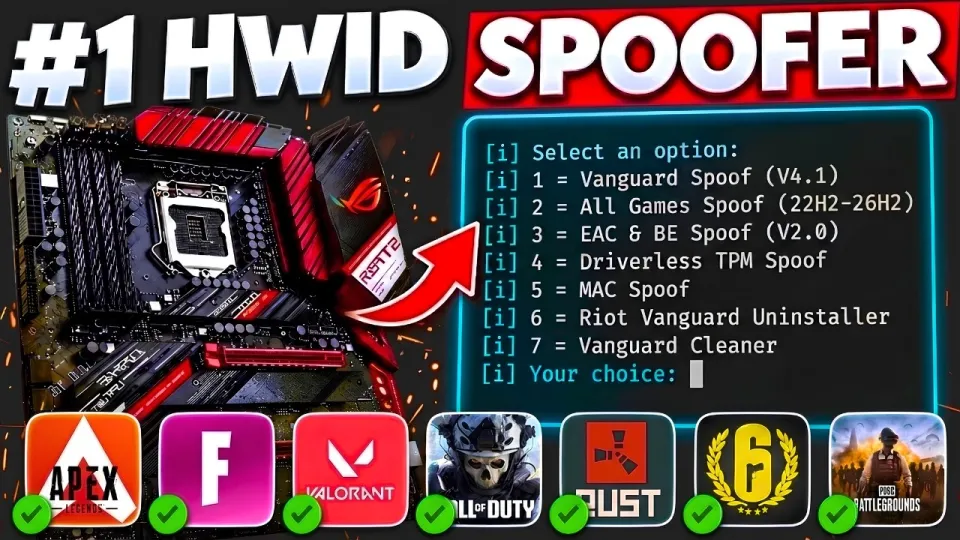
Video: HWID Spoofer Full Guide: How To Get Unbanned From Any Game Fast! (Best HWID Spoofer)
Key takeaways
- An HWID spoofer replaces the hardware identifiers a game reads — disk serials, motherboard and BIOS data, MAC addresses, SMBIOS strings — so a flagged machine looks like a new one.
- The Zaliant permanent spoofer advertised in the breakdown includes a TPM bypass, which matters for Valorant, whose Vanguard anti-cheat reads TPM and Secure Boot state.
- The product page claims no Windows reinstall is required and support for all motherboards, with a listed base of 3000+ customers.
- A hardware ban is server-side: the game blocks your machine's fingerprint, not just your account, so a new account alone does not lift it.
- Spoofers are against every major game's terms of service; a ban evasion can lead to a permanent device block and a fresh account ban.
The best HWID spoofer is a tool that changes the hardware identifiers a game or anti-cheat reads from your PC — disk serial numbers, motherboard and BIOS strings, MAC addresses, SMBIOS data and, for Valorant, TPM and Secure Boot state — so a hardware-banned machine is treated as a new one. The commercial option shown in the breakdown is the Zaliant permanent spoofer, sold as a one-time purchase with a TPM bypass and no Windows reinstall. It is not a magic unban: it hides the machine, and the account ban on top of it stays.
What an HWID ban actually is
A hardware ban is a server-side block on your machine's fingerprint, not on your login, which is why making a new account does nothing. When an anti-cheat issues a ban, it stores a hash built from several device identifiers. On the next launch it recomputes that hash and refuses to let the client connect. The exact ingredient list differs per game, but the usual suspects are:
- Volume serial number and disk device serials (system drive first).
- Motherboard and BIOS data: SMBIOS UUID, board serial, baseboard product strings.
- Network adapter MAC addresses, including virtual adapters left by VPNs and emulators.
- Windows machine GUID and product ID in the registry.
- GPU and monitor EDID data, sometimes the monitor serial.
- For Valorant specifically: TPM 2.0 presence and state, Secure Boot status, and the EFI variables behind them.
Because the fingerprint is a combination, changing one field is rarely enough. A tool that only randomizes the volume serial will still leave the same SMBIOS UUID, and the ban holds. That is the main technical reason cheap "free HWID spoofers" fail on Valorant, Rust and Call of Duty.
How the Zaliant spoofer is presented in the breakdown
The Zaliant package is marketed as a permanent spoofer with a TPM bypass, aimed at Valorant, Fortnite, Rust, Call of Duty and FiveM hardware bans. The vendor's claims, as listed on the product page and in the video description, are specific enough to check one by one:
- TPM bypass included. Valorant's Vanguard reads TPM and Secure Boot state; a spoofer without a TPM layer leaves that signal intact.
- No Windows reset required. Older methods meant reinstalling the OS and wiping drives; this one runs from the desktop.
- All motherboards supported. The claim covers both desktop boards and laptop chipsets, which matters because laptop BIOS strings are harder to touch.
- 3000+ satisfied customers and constant updates, per the vendor.
- Discord-based support with a license tied to the purchase.
The purchase flow shown is short: buy on the site, join the Discord, receive the loader, run it, reboot, then launch the game on a fresh account.
Step-by-step: using an HWID spoofer safely
The order of operations matters more than the tool itself, because a mistake before the spoof undoes the result. A workable sequence:
- Uninstall the game and the anti-cheat completely. Remove leftover service folders and driver entries; a stale Vanguard or Easy Anti-Cheat install can carry old identifiers.
- Change your network identity first. A new IP is not part of the hardware fingerprint, but the same IP right after a ban is an easy secondary signal. Avoid free VPN pools that are already flagged.
- Run the spoofer as administrator and let it finish. Do not close the window mid-write; a half-applied SMBIOS change can leave the machine unbootable.
- Reboot, then verify. Check the disk serial, the SMBIOS UUID and the MAC address in System Information and the registry before touching the game.
- Create a clean account with a new email, and do not log into old linked accounts from the same machine.
- Keep the license updated. Anti-cheats push detection updates; a spoofer that worked last month can be flagged this month.
Two practical warnings. First, never run a spoofer on a machine you use for work or banking — these tools write to low-level firmware and registry areas, and a failed write is a reinstall at best. Second, check whether your motherboard vendor exposes a BIOS update utility; the cleanest way to restore real identifiers later is a BIOS reflash plus a Windows reinstall.
Why free spoofers usually fail
Free HWID spoofers are typically open-source scripts that change two or three registry keys and call it done. Anti-cheats hash dozens of values, and several of them — TPM endorsement keys, EFI variables, drive firmware serials — cannot be edited from user mode at all. A free tool also has no update pipeline, so the moment the anti-cheat vendor adds a check for the method, every user of that tool is flagged again. The realistic outcomes are a wasted evening, a corrupted Windows install, or a second ban that is harder to appeal. Paid tools are not immune either: the value is in the maintenance, not the executable.
Risks, rules and what a spoofer cannot fix
Spoofing is a terms-of-service violation in every game that issues hardware bans, and publishers treat ban evasion as a separate, more serious offence than the original cheat. Realistic risks:
- Permanent device blocks that survive spoofing once the method is detected.
- Account bans on the new account, sometimes within hours if behaviour matches the old one.
- Firmware damage from a badly written SMBIOS or TPM change.
- Payment and account risk if the same card or email is reused.
A spoofer also cannot restore a legitimately banned account, recover skins or progress, or protect you if you keep cheating after the spoof. If your ban came from a false positive — a shared PC, a compromised account — the support ticket is the better route, and it costs nothing.
Where to buy and what else is linked
All official links from the breakdown, in one place:
- Product page (permanent spoofer): https://www.zaliantservices.com/products/permanentspoofer
- Store front: https://www.zaliantservices.com
- Discord community and support: https://discord.gg/zaliant
Before paying, confirm the license duration, whether updates are included, the refund policy and whether your motherboard and game are on the supported list. Ask in the Discord which anti-cheat versions the tool currently covers; a vendor that answers specifically is a better sign than one that promises "all games".
Summary
An HWID spoofer works by rewriting the hardware fingerprint an anti-cheat hashes, and the Zaliant build shown in this breakdown adds a TPM bypass for Valorant plus a no-reinstall flow, with a listed base of 3000+ customers. The steps that decide success are uninstalling the anti-cheat, changing network identity, rebooting and verifying the new identifiers before creating a clean account. The risks are real: firmware damage, permanent device blocks and fresh account bans, all on top of a terms-of-service violation. If you accept those terms, the permanent spoofer product page is where the purchase starts. The video walkthrough was published by the channel 芸芸记录生活.
Source: HWID Spoofer Full Guide: How To Get Unbanned From Any Game Fast! (Best HWID Spoofer) · Markdown version
Questions & answers
Does an HWID spoofer actually unban my account?
No. An account ban lives on the game's servers and a spoofer cannot touch it. What a spoofer does is change the hardware fingerprint so a new account can run on the same machine without tripping the hardware block. The old account stays banned.
Why does Valorant need a TPM bypass in a spoofer?
Vanguard reads TPM 2.0 and Secure Boot state as part of the machine fingerprint. A spoofer that only changes disk serials and MAC addresses leaves the TPM data intact, so the hardware ban still matches. The TPM bypass is the layer that addresses this check.
Do I need to reinstall Windows after spoofing?
Not with the tool shown in this breakdown, which is advertised as requiring no Windows reset. Older manual methods did require a full OS reinstall and drive wipe. A reboot after running the spoofer is still needed so the new identifiers are loaded.
Is using an HWID spoofer bannable?
Yes. Spoofing violates the terms of service of every major game that issues hardware bans, and publishers treat ban evasion as a separate offence. Detection can lead to a permanent device block and an immediate ban on the new account, and a bad firmware write can leave the machine needing a reinstall.